





This week marks the 86th anniversary of Igor Sikorsky’s first successful helicopter flight, a milestone that redefined aviation. Sikorsky proved that vertical flight was not only possible but practical, and in doing so, he laid the foundation for a technology that has become indispensable to both civilian and military operations.
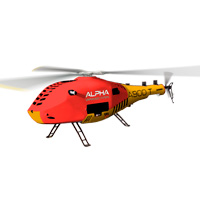
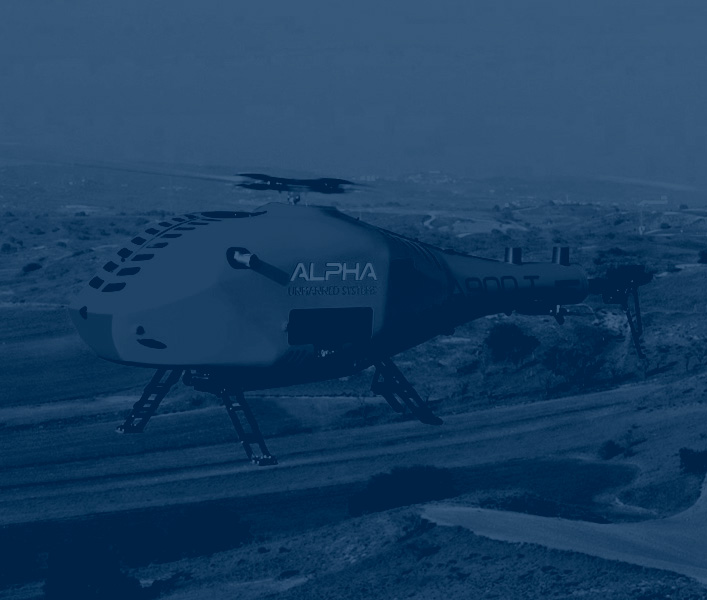
More than eight decades later, that legacy continues, now extended into the unmanned era. Helicopter UAVs carry Sikorsky’s vision forward, providing armed forces with persistence, flexibility, and endurance that no other unmanned platform can match.
Types of Unmanned Aerial Platforms
In general terms, unmanned aerial platforms fall into several distinct categories.
Fixed-wing UAVs are designed like conventional airplanes. They can fly long distances and carry relatively heavy payloads efficiently, but they require runways or special launch and recovery equipment. This can limit their use in environments where space is constrained or infrastructure is minimal.
Multi-rotor drones include quadcopters, hexacopters, and octocopters are familiar platforms used in the the commercial sector. Their simplicity and maneuverability are attractive, but they are almost always battery powered, restricting their practical endurance to less than an hour.
Tiltrotors and VTOL hybrids attempt to combine the endurance of a fixed-wing with the flexibility of vertical take-off and landing (VTOL). While innovative, they remain mechanically complex, relatively unproven at scale, and are still subject to battery limitations.
Rotary UAVs, or unmanned helicopters, represent a different approach. These platforms uniquely combine VTOL capability with endurance and payload capacity, filling a gap that neither fixed-wing nor multi-rotor platforms can fully address.

Why Helicopter UAVs Are Unique
Rotary UAVs deliver operational agility and versatility that are unmatched by other unmanned platforms. Their VTOL capability allows them to take off and land vertically from confined spaces, whether a ship’s deck, a forest clearing, or a forward operating site. No runway, catapult, or recovery net is required, which reduces the logistics footprint and allows rapid deployment in complex mission theatres.
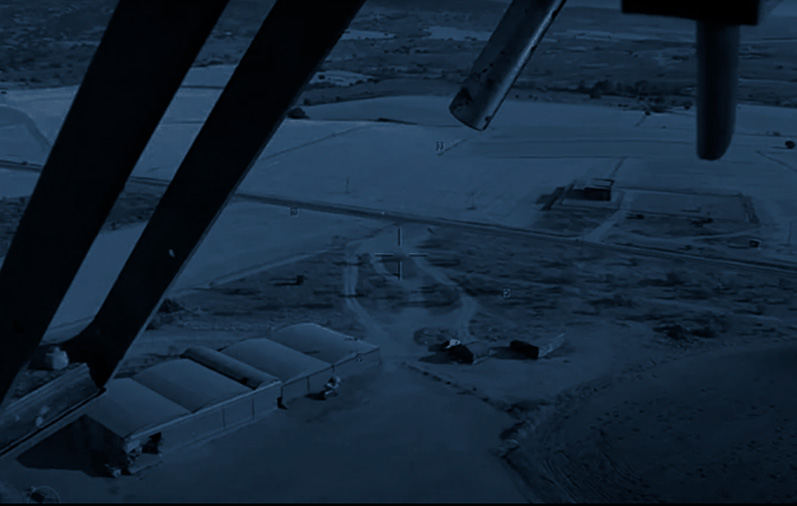
They also excel in slow flight and hovering. Unlike fixed-wing UAVs, unmanned helicopters can hover over a specific point or move at very low speeds. This makes them invaluable for intelligence, surveillance, and reconnaissance (ISR) missions. They can observe a moving convoy, scan a target area, or provide persistent overwatch for advancing troops. Hovering capability is the key to practical persistent surveillance.
Endurance: A Critical UAV Differentiator
Alpha’s helicopter UAVs are fuel powered, providing flight endurance of up to four hours. This is a decisive advantage for all of our customers.
Battery-powered multicopters or electric VTOL drones rarely exceed an hour of flight time. In ISR missions, this restrictive endurance is insufficient. Deploying multiple battery-powered drones to cover the same surveillance window requires constant swapping, recharging, and repositioning, adding complexity and risk.
Fuel-powered rotary UAVs overcome these limitations. With four hours of sustained flight, they can perform meaningful ISR tasks, extend communications, support search and rescue, and remain on station long enough to deliver continuous, actionable intelligence.
The Complexity of Helicopter Engineering
The benefits of rotary UAVs come at the price of engineering complexity. A famous saying captures this with humor: “A helicopter is 10,000 parts flying in formation.”
Unlike multi-rotors, helicopters rely on intricate rotor systems, transmissions, and control mechanisms. The aerodynamic, mechanical, and electronic design and manufacturing challenges are significant. Developing a reliable, stable, and enduring helicopter UAV requires years of specialized expertise.
Alpha Unmanned Systems has embraced this challenge by dedicating itself exclusively to rotary UAVs. From our base in Spain, we have developed deep engineering capabilities that few other companies in Europe can match. This singular focus has allowed us to build robust, proven platforms that defense forces in more than twelve countries trust for their most demanding missions.

Trusted by Defense Forces Worldwide
Alpha’s platforms have been deployed in a wide range of operational contexts: border surveillance, maritime surveillance, reconnaissance, and border protection. The adaptability of helicopter UAVs allows them to move seamlessly across these mission profiles, making them indispensable aerial platforms for modern defense forces.
These missions are increasingly being enhanced through manned-unmanned teaming. By pairing crewed helicopters with rotary UAVs such as our A900, defense forces can extend operational reach, reduce pilot workload, and mitigate risk to crews.
Rotary UAVs can scout ahead of manned aircraft, detect threats, and assume high-risk reconnaissance tasks. They can also act as effective communication relays, extending data connectivity into contested environments. This concept is gaining traction among European and NATO forces, and rotary UAVs are uniquely suited to fill the role.
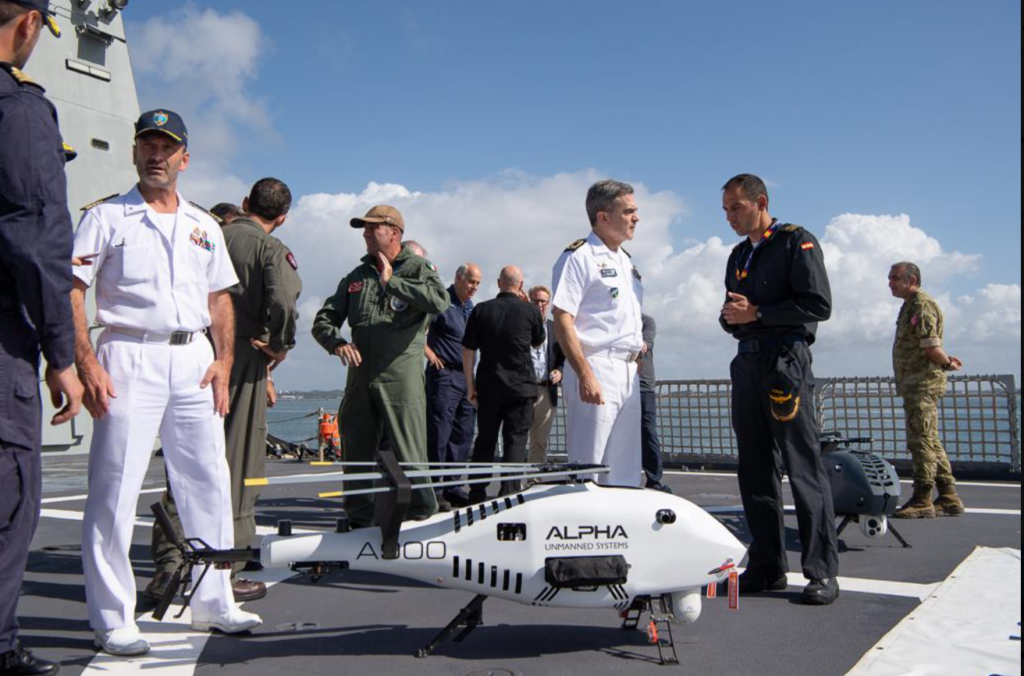
European Leadership & UAV Innovation
Alpha’s expertise has also been recognized at a European level, selected by the European Defence Fund to participate in the development of next-generation combat helicopter platforms, in partnership with Airbus Helicopters.
This project underscores the strategic importance of rotary UAVs in Europe’s defense plans, while highlighting Alpha’s role as a trusted and capable partner. Few companies bring the same degree of focus and expertise in unmanned rotary platforms, and this recognition reflects our ability to contribute to the continent’s future defense architecture.
Closing Thoughts: Helicopter UAV Platforms as Key Strategic Assets
From Sikorsky’s pioneering first flight to the unmanned systems of today, rotary aviation has consistently pushed the boundaries of what is possible. Rotary UAVs bring together a unique combination of capabilities. They can operate from the smallest of spaces, hover and loiter in ways no other unmanned platform can, and when fuel powered, they can remain airborne for hours. These attributes make them ideally suited to ISR and surveillance missions, as well as to the emerging military practice of manned-unmanned teaming.
As defense challenges evolve, the need for reliable, enduring, and versatile UAV platforms will only grow. Rotary UAVs, with their distinctive combination of persistence and flexibility, will remain central to meeting those challenges. At Alpha Unmanned Systems, we are committed to pushing the boundaries of what rotary UAVs can achieve, ensuring that our partners continue to benefit from their decisive operational advantages.
For more information on our tactical helicopter UAV platforns, reach out to our team.